Australia is running out of landfill space faster than most people realise, and every tonne of material diverted from landfill genuinely matters. Copper is one of the most valuable materials that should never end up in the ground. At Austick, we collect and recycle scrap copper across NSW, helping businesses, tradies, and demolition contractors keep valuable material out of landfill and in productive use.
Table of Contents
Key Takeaways
- Metals have a 90% resource recovery rate, the highest of any waste category in Australia.
- Greater Sydney landfills are expected to reach capacity by 2030.
- Copper is 100% recyclable and never loses quality through the process.
- Recycling copper saves up to 85% more energy than mining new copper ore.
- Every kilogram of copper recycled supports Australia’s national waste targets.
Australia’s Landfill Problem Is Real and Growing
NSW generated 22.4 million tonnes of waste in 2024-25, a 5% increase on the previous year, according to the NSW EPA waste performance data. While the state’s overall recycling rate reached 67%, that still means roughly one third of all waste generated is heading to landfill. And the clock is ticking.
Greater Sydney’s landfills are expected to reach capacity by 2030, a reality that makes responsible material diversion more urgent than ever. When businesses and tradies take scrap copper to a recycler rather than putting it in a skip, they are directly contributing to that diversion effort.
Australia’s National Waste Policy Action Plan sets a target of an 80% resource recovery rate by 2030, a goal that is ambitious given the current national average sits around 66%, according to the 2024 National Waste and Resource Recovery Report. Meeting that target requires every category of recoverable material, including metals, to be kept out of landfill.
Metals Lead the Way in Resource Recovery
Metals are already the best-performing waste category in Australia. The National Waste and Resource Recovery Report 2024 puts the estimated resource recovery rate for metals at 90%, the highest of any material category recorded. Copper, as a high-value recyclable metal, sits at the core of this performance.
CSIRO research into Australia’s circular economy confirms that the country’s overall circularity rate, the proportion of materials reused or recycled rather than drawn from virgin sources, currently sits at around 4%. That figure needs to increase substantially. Copper recycling is one of the fastest and most economically viable ways to contribute to that shift.
Australia’s National Waste Policy has a target of diverting 80% of all waste from landfill by 2030. Copper recycling plays a direct role in meeting that commitment because it diverts material that would otherwise consume scarce landfill space.
Why Copper Should Never Go to Landfill
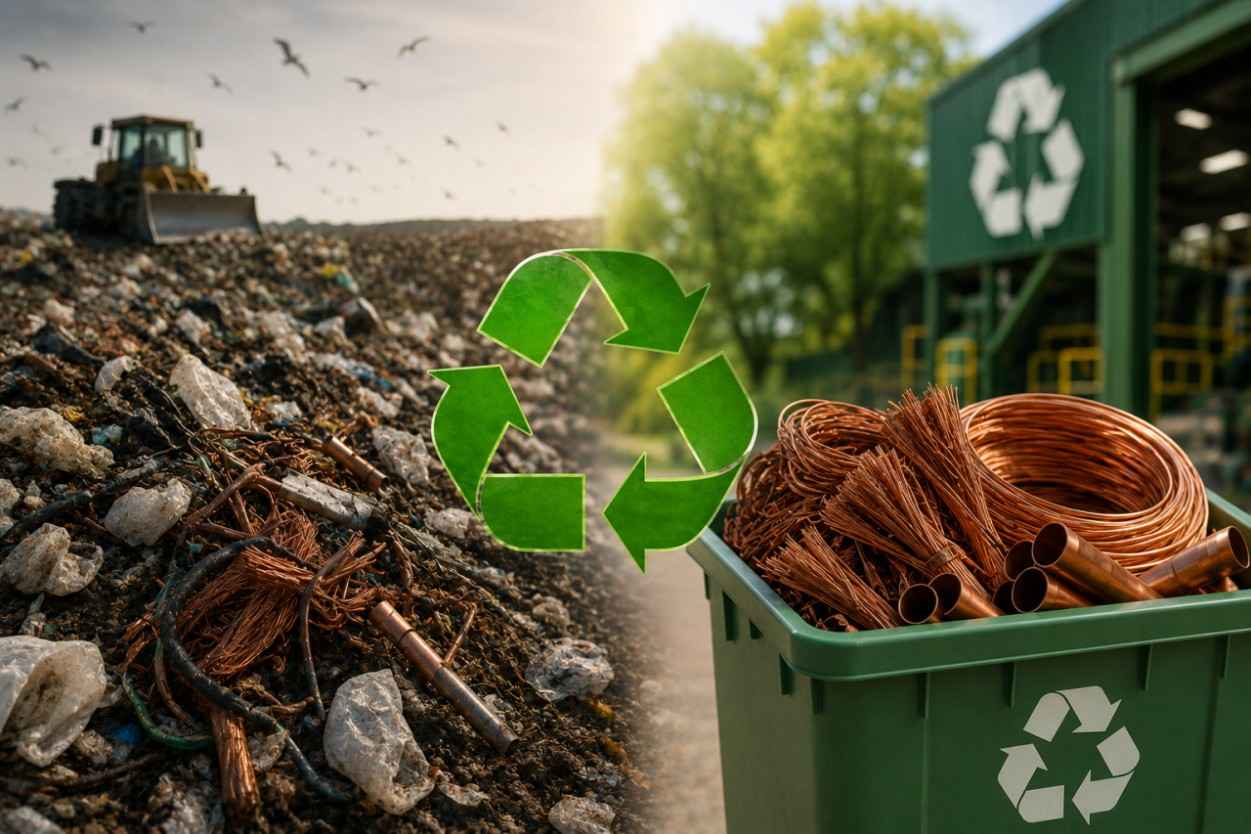
Unlike many other materials, copper does not degrade in quality when it is recycled. It can be melted down and reformed repeatedly without any loss of performance. This makes landfilling copper not just wasteful but genuinely counterproductive. The material is fully usable in its recycled form and is in high demand.
Almost one third of global copper demand is currently met through recycled sources. The International Energy Agency projects that nearly half of all copper demand by 2040 will come from clean energy technologies including solar panels, electric vehicles, and wind turbines. Recycled copper feeds directly into that supply chain.
When copper goes to landfill, it represents a permanent loss of material that took enormous energy and resources to extract, process, and manufacture in the first place. Recovering it from landfill at a later stage, if possible at all, costs far more than simply recycling it before disposal.
The global copper scrap recycling market is set for strong compound annual growth of 10.6% through to 2032. That demand signal makes every tonne of copper diverted from landfill economically valuable as well as environmentally important.
The Energy Equation: Recycling Versus Mining
One of the most compelling environmental arguments for copper recycling is the energy saved compared to primary production. Recycling copper from scrap requires significantly less energy than smelting new copper from ore. Estimates across research literature suggest recycled copper production can use up to 85% less energy than mining and refining virgin copper.
When you reduce energy consumption, you reduce greenhouse gas emissions. For a country like Australia, where the construction and demolition sector generates enormous volumes of copper scrap through plumbing, wiring, and air conditioning systems, the cumulative energy and emissions benefit of diverting that material to recycling rather than landfill is substantial.
The NSW EPA’s environmental benefits of recycling analysis confirms that recycling metals, including copper, delivers measurable gains in energy conservation, greenhouse gas abatement, and landfill space savings compared to disposal.
Where Does Copper Scrap Come From in NSW?
For most NSW businesses and tradespeople, copper scrap arises from everyday work. The most common sources include:
- Plumbing pipe and fittings removed during renovations or demolished from older buildings
- Electrical wiring and cables stripped from construction sites or end-of-life structures
- Air conditioning and refrigeration units containing copper tubes and coils
- Industrial machinery with copper windings and electrical components
- Roofing copper from heritage or commercial buildings undergoing refurbishment
Each of these streams represents material that would otherwise go into a skip, a mixed waste bin, or directly to landfill. When this copper is separated and sent to a recycler, it is diverted from landfill, processed with significantly lower environmental impact than mining, and fed back into manufacturing supply chains.
Construction and Demolition Waste: The Biggest Opportunity
The construction and demolition sector is the largest generator of waste in Australia. NSW EPA data shows that the C&D stream’s recycling rate held at 80% in 2024-25, which is strong relative to other categories. But the scale of waste generated in this sector means even small improvements translate into thousands of tonnes kept out of landfill each year.
For demolition contractors and construction businesses, copper is consistently one of the highest-value recoverable materials on site. Separating copper pipe, wiring, and air conditioning materials from general demolition debris before disposal is both financially and environmentally smart.
Design and material separation decisions during demolition have the greatest potential to minimise the volume of materials going to landfill. Copper separation is one of the simplest and most valuable of those decisions.
Demolition teams can identify and separate copper from different type of scrap metal before it gets mixed into general waste.
For businesses generating larger volumes of scrap copper, scrap metal recycling services at Austick in Sydney include free pickup, which removes the logistical barrier to recycling entirely.
Conclusion
Copper recycling is not just about earning money from your scrap. It is about keeping a genuinely valuable material out of landfills that are already under serious pressure across Greater Sydney and NSW. Every load you divert contributes to Australia’s national recovery targets and reduces the environmental cost of new copper production. Contact us today and we will handle the rest, with free pickup across NSW.
FAQs:
Does copper go to landfill in Australia?
Copper often ends up in landfill when not separated from general waste. It should always be recycled instead.
Why is it important to recycle copper instead of throwing it away?
Copper is 100% recyclable, conserves energy, and diverts material from landfills that are reaching capacity.
How much energy does recycling copper save compared to mining?
Recycling copper uses up to 85% less energy than extracting and refining new copper from ore.
What is Australia’s landfill waste reduction target?
Australia’s National Waste Policy targets an 80% resource recovery rate from all waste by 2030.
What types of copper waste can be recycled instead of landfilled?
Copper pipe, wiring, electrical cable, air conditioning coils, and roofing copper are all recyclable.
Does copper lose quality when it is recycled?
No. Copper can be recycled indefinitely without any loss of performance or material quality.